
Turmeric Capsules vs Turmeric Powder: Which Form Fits Your Routine?
Turmeric is a familiar Ayurvedic and culinary ingredient, but turmeric powder and turmeric capsules are not interchangeable in every situation. The form you choose affects convenience, serving size, formulation and how clearly you can compare the product label. This guide explains the practical differences while separating traditional Ayurvedic use from modern clinical evidence.
Turmeric Powder vs Capsules at a Glance
| Factor | Turmeric powder | Turmeric capsules |
|---|---|---|
| Format | Loose powder, commonly used in food or drinks | Pre-measured supplement serving |
| Convenience | Flexible, but requires measuring and preparation | Portable and simple to take according to the label |
| Label comparison | Often focuses on the whole turmeric ingredient | May specify turmeric extract, curcuminoids, or other ingredients |
| Evidence | Evidence from concentrated extracts cannot automatically be applied to ordinary culinary powder | Evidence depends on the exact extract, dose and formulation studied |
| Best buying question | What is the ingredient, serving size and intended use? | What form of turmeric or curcumin is present, and what else is included? |
What Is Turmeric Used for in Ayurveda?
Turmeric (Curcuma longa) has a long history in Indian traditional medicine and cooking. Ayurveda has traditionally used turmeric in a variety of wellness contexts, including digestive and skin-related practices. These traditional uses provide cultural and historical context, but they should not be presented as proof that turmeric supplements treat a diagnosed disease.
The U.S. National Center for Complementary and Integrative Health (NCCIH) notes that turmeric and curcumin have been studied for several conditions, but the evidence is not strong enough to conclude that oral turmeric or curcumin is beneficial for every health purpose. Formulations also vary considerably.
Turmeric Powder: When Does It Make Sense?
Turmeric powder is the more familiar whole-spice format. It can be added to meals or drinks and allows you to use a small amount as part of normal food preparation. It is particularly practical for people who want turmeric primarily as a culinary ingredient rather than as a concentrated supplement.
Advantages of turmeric powder
- Easy to incorporate into cooking and everyday meals.
- Flexible serving size for culinary use.
- Does not require swallowing capsules.
- Works well for people who prefer whole-ingredient formats.
What to check
Check the ingredient list, net weight, serving guidance, packaging and storage instructions. Do not assume that a spoonful of ordinary turmeric powder is equivalent to a capsule containing a standardized curcumin extract; the compositions and amounts can be very different.
Turmeric Capsules: When Are They More Convenient?
Capsules provide a pre-measured format and can be easier to fit into a busy routine. However, “turmeric capsule” can describe very different formulations. Some products contain turmeric powder, while others contain concentrated extracts or curcuminoids and may include ingredients intended to increase bioavailability.
Advantages of capsules
- Convenient and portable.
- Serving size is clearly defined on the label.
- Less preparation than powder.
- Often easier to compare supplement formulations by ingredient and amount.
Because clinical studies frequently use specific extracts or curcumin formulations, study results should not automatically be transferred to every turmeric capsule on the market.
What Does Modern Research Say?
Research on turmeric and curcumin is most developed in areas such as osteoarthritis, but the evidence remains formulation-specific. NCCIH describes the evidence for knee osteoarthritis as initially positive while noting that higher-quality research is needed. Systematic reviews and meta-analyses of randomized trials have reported improvements in pain and physical function in some knee osteoarthritis studies, but differences in products, doses and study quality make it difficult to identify one universally effective formulation.
That distinction matters when comparing powder with capsules: a study of a concentrated curcumin extract is not evidence that ordinary culinary turmeric powder will produce the same outcome.
Featured Turmeric Option at Ayurveda Health Mart
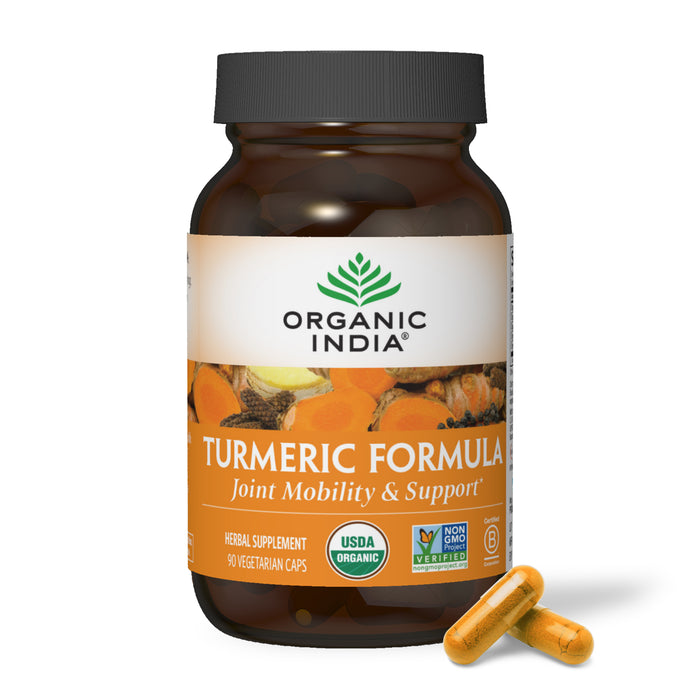
Organic India Turmeric Formula – 90 Vegetarian Capsules: A convenient capsule format for customers who prefer a measured turmeric supplement rather than loose powder. View the Organic India Turmeric Formula and review the current label before use.
For more help comparing supplement quality, see our guide to choosing an Ayurvedic supplement online.
Product information and availability can change. Follow the current product label and do not use a supplement as a substitute for professional medical care.
How to Choose the Right Format
Choose powder if you want a food-first format
If your goal is simply to include turmeric in meals, powder is usually the more flexible option. It lets you treat turmeric as a culinary ingredient rather than automatically approaching it as a concentrated supplement.
Choose capsules if convenience matters most
If measuring and preparing powder is inconvenient, capsules can provide a simpler routine. Read the label carefully because the amount of turmeric, curcuminoids and additional ingredients can vary substantially between products.
Choose based on the formulation—not just the word “turmeric”
Compare the botanical name, plant part where stated, extract or powder description, serving size, other ingredients, manufacturer information and storage instructions. If a product claims enhanced bioavailability, understand that this may also change its safety considerations.
Safety, Interactions and Who Should Ask a Professional
Turmeric supplements can cause gastrointestinal effects such as nausea, reflux, stomach upset, diarrhea or constipation. NCCIH also reports liver injury with some highly bioavailable curcumin formulations. Pregnancy is a reason to avoid turmeric supplements unless a qualified healthcare professional specifically advises otherwise; there is also limited information about amounts above normal food use during breastfeeding.
People taking prescription medicines, living with a chronic condition, preparing for surgery, or considering concentrated turmeric or curcumin should speak with a doctor or pharmacist before starting a supplement. Seek prompt medical advice if you develop symptoms such as unusual fatigue, poor appetite, dark urine or jaundice after taking a turmeric or curcumin product.
Frequently Asked Questions
Are turmeric capsules stronger than turmeric powder?
Not automatically. Capsules can contain either turmeric powder or a more concentrated extract. Compare the actual formulation and serving information rather than the format alone.
Can I use turmeric powder every day?
Turmeric used as a normal food ingredient is different from taking a concentrated supplement. If you plan to use larger supplemental amounts regularly, check the product label and discuss it with a healthcare professional when appropriate.
Is curcumin the same as turmeric?
No. Curcumin is a group of compounds found in turmeric and is one of its major constituents. A curcumin extract can therefore be substantially different from ordinary turmeric powder.
Should I choose a turmeric product with black pepper?
Some products include piperine to increase curcumin bioavailability, but higher bioavailability can also affect safety and medicine interactions. Do not assume that increased absorption is automatically better for everyone.
Bottom Line
Turmeric powder is a flexible culinary option, while capsules can offer convenience and a clearly defined supplement serving. Neither format is universally “better.” The most sensible choice depends on whether you want a food ingredient or a specific supplement formulation, and on your individual health circumstances.
Ready to compare? Review the Organic India Turmeric Formula, read the label carefully, and explore the Ayurveda Health Mart blog for more evidence-aware Ayurvedic ingredient and buying guides.
References
- NCCIH: Turmeric — Usefulness and Safety.
- Systematic review of turmeric or curcumin for pain and function in knee osteoarthritis.
- Systematic review and meta-analysis of turmeric extracts for knee osteoarthritis.
- 2026 umbrella review of curcumin formulations in osteoarthritis.
Educational information only. This article does not diagnose, treat, cure or replace advice from a qualified healthcare professional.