
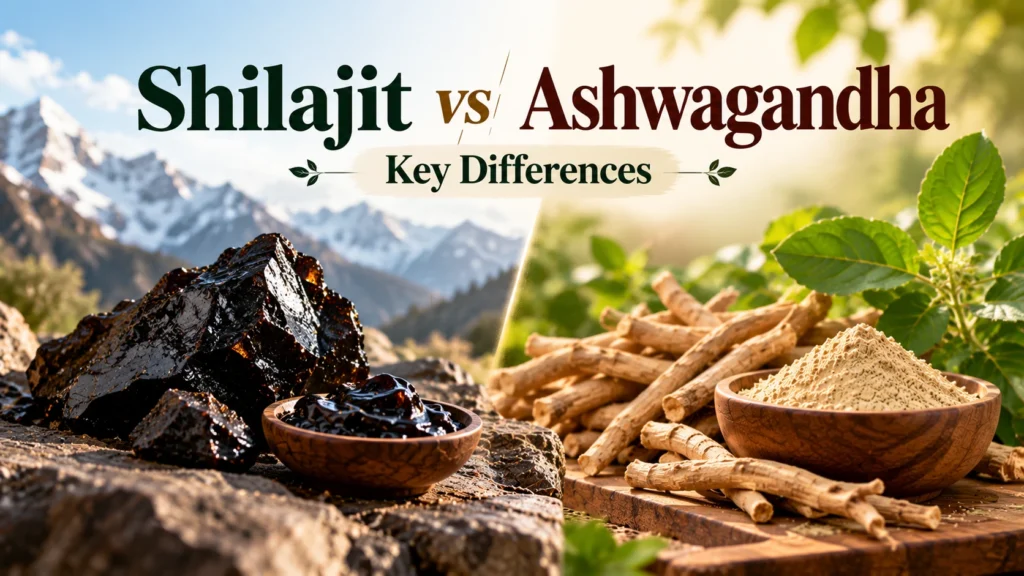
Shilajit vs Ashwagandha for Daily Wellness: Key Differences
Shilajit and Ashwagandha are both widely used in Ayurveda, but they are not interchangeable. Ashwagandha is a botanical (Withania somnifera), while Shilajit is a complex natural phyto-mineral substance traditionally collected from mountain rock. Their traditional roles, research base and practical considerations differ.
This guide compares them without assuming that either supplement will treat or prevent disease. If you are deciding between them for everyday wellness, the best choice depends on your goal, health history, medicines and product quality.
Shilajit vs Ashwagandha at a Glance
| Feature | Shilajit | Ashwagandha |
|---|---|---|
| What it is | Phyto-mineral substance containing humic compounds and minerals | Herbal root/extract from Withania somnifera |
| Traditional Ayurvedic context | Used as a rasayana or rejuvenative substance | Used as a rasayana and traditionally associated with resilience and vitality |
| Common modern interest | Energy, stamina and physical performance | Stress, sleep and general wellbeing |
| Human evidence | Limited; several small studies exist | More human trials, particularly for stress and sleep, but evidence is still not definitive |
| Quality issue to consider | Purification and contaminant/heavy-metal testing are especially important | Extract standardisation, dose and ingredient transparency matter |
What Is Shilajit?
Shilajit is a dark natural material associated with mountainous regions and has a long history in traditional medicine. Chemical reviews describe it as a complex mixture containing humic substances, minerals and other compounds, with composition varying by source. Modern research has explored physical performance and fatigue, but the overall clinical evidence remains limited.
A 2019 randomized study in recreationally active men found that a standardized Shilajit preparation at one studied dose was associated with better retention of muscular strength after a fatiguing protocol. A more recent small, open-label pilot also reported improvements in several performance measures, but its uncontrolled design means the results should be interpreted cautiously.
What Is Ashwagandha?
Ashwagandha is an Ayurvedic herb commonly prepared from the root. Modern trials and reviews have investigated stress, sleep and other outcomes. Results are promising in some areas, but formulations and doses differ between studies, so supplement labels should not be treated as equivalent to clinical-trial preparations.
For a deeper introduction, read our Ashwagandha benefits, uses, dosage and timing pillar guide. You can also explore what the evidence says about Ashwagandha for stress and sleep.
Which One Fits Different Daily-Wellness Goals?
For stress and sleep support
Ashwagandha has the more directly relevant human research for stress and sleep-related outcomes. That does not mean it works for everyone or replaces evaluation for persistent anxiety, insomnia or other health concerns. Our morning-or-night Ashwagandha guide discusses practical timing.
For vitality and physical performance
Shilajit has traditionally been associated with vitality, and a small body of human research has examined fatigue and physical performance. The evidence is not strong enough to promise increased energy or stamina. See our Shilajit benefits for men guide for a closer look at the research.
For a simple, evidence-aware choice
If stress or sleep is your primary interest, Ashwagandha currently has a broader human evidence base. If your interest is traditional vitality or physical-performance research, Shilajit may be the more relevant ingredient to discuss with a qualified professional. Neither should be selected solely because of exaggerated social-media claims.
Explore Shilajit at Ayurveda Health Mart
Looking for a ready-to-use Shilajit format? View Himalaya Shilajit – 60 Capsules for current product details, label information and availability.
Product information is for shopping and educational purposes and is not a medical recommendation.
Can You Take Shilajit and Ashwagandha Together?
Traditional use and modern supplement practice sometimes combine them, but there is not enough high-quality clinical evidence to conclude that the combination is more effective than either ingredient alone. Combining supplements can also make it harder to identify which ingredient caused an unwanted effect. Read our dedicated guide: Can you take Ashwagandha and Shilajit together?
Safety, Interactions and Product Quality
Ashwagandha: Seek professional advice before use if you are pregnant or breastfeeding, have thyroid or autoimmune conditions, are preparing for surgery, or take medicines that affect thyroid function, blood sugar, blood pressure, immunity or sedation. Rare liver-injury reports have also been associated with Ashwagandha-containing supplements.
Shilajit: Quality control is particularly important. Published analyses show that composition varies and that raw or poorly controlled material may contain undesirable metals. Choose purified products from reputable manufacturers with appropriate contaminant testing. People with chronic medical conditions, those who are pregnant or breastfeeding, and anyone taking regular medicines should discuss use with a clinician or pharmacist.
Do not use either supplement as a substitute for prescribed treatment. Stop use and seek medical advice if you develop a significant or unexpected reaction.
How to Choose a Product
- Check the complete ingredient list and serving size.
- Prefer manufacturers that provide clear batch, quality and contaminant information.
- Avoid products promising cures, instant results or guaranteed hormonal effects.
- Use the label directions rather than copying doses from unrelated studies.
- Introduce one new supplement at a time when practical.
Browse the Ayurveda & Wellness Blog for more ingredient comparisons and practical use guides. If Shilajit matches your wellness goals, you can also review Himalaya Shilajit product details here before deciding whether it is appropriate for you.
Frequently Asked Questions
Is Shilajit better than Ashwagandha?
Not generally. They are different substances with different traditional uses and research profiles. The more appropriate choice depends on your goal, health history and medications.
Which is better for stress: Shilajit or Ashwagandha?
Ashwagandha has more direct human research related to stress. Results are not guaranteed, and persistent or severe symptoms warrant professional assessment.
Which is better for energy?
Shilajit has traditional associations with vitality and some small studies have investigated physical performance and fatigue. Current evidence is not sufficient to promise an energy-boosting effect.
Can women take Shilajit or Ashwagandha?
Sex alone does not determine suitability. Pregnancy, breastfeeding, medical conditions and medicines matter. Professional guidance is appropriate when any of these apply.
References
- Review on Shilajit used in traditional Indian medicine – PubMed
- Comprehensive review of Shilajit chemical composition – PubMed
- Shilajit supplementation and fatigue-induced muscular strength – PubMed
- Elemental and heavy-metal analysis of Shilajit – PubMed
Medical note: This article is educational and does not provide diagnosis or individualized treatment advice. Consult an appropriately qualified healthcare professional when choosing supplements, particularly if you have a medical condition or use medication.