
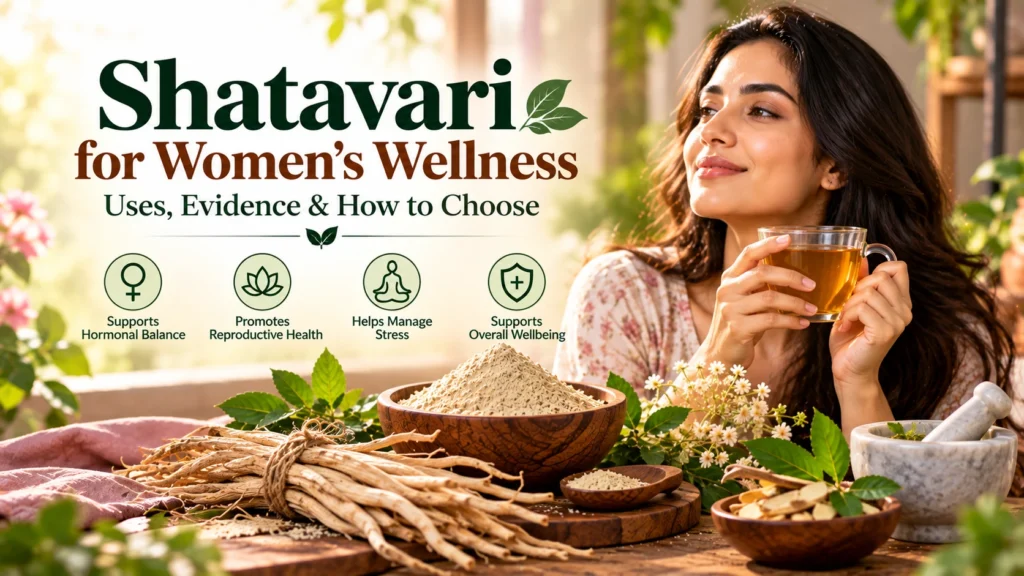
Shatavari (Asparagus racemosus) has a long history of use in Ayurveda, particularly in traditional approaches to women’s wellness. Today, shoppers often search for Shatavari for menopause, reproductive wellness, stress, lactation and everyday vitality—but traditional use and modern clinical evidence are not the same thing.
This guide explains what Shatavari is, what emerging research suggests, how common product formats differ, and how to choose a Shatavari product responsibly.
What Is Shatavari?
Shatavari is a botanical used in Ayurvedic practice. The root is the part most commonly used in powders, capsules and standardized extracts. Traditional use is broad, while modern human research is still developing and often evaluates specific standardized extracts rather than every Shatavari product sold commercially.
Why Do Women Use Shatavari?
Common reasons include general women’s wellness, support during life-stage changes and interest in traditional Ayurvedic routines. Recent randomized trials have investigated standardized Shatavari root extracts for perimenopausal and menopausal symptoms, with promising results in some symptom and quality-of-life measures. However, these studies do not prove that all Shatavari powders or supplements will produce the same effects.
For readers who want to examine the research directly, see the randomized placebo-controlled perimenopause study indexed in PubMed and a 2025 randomized study of Shatavari and Ashwagandha in postmenopausal women.
Shatavari Powder vs Capsules: Which Format Makes Sense?
Shatavari root powder
Powder is useful for people who prefer a traditional, flexible format that can be measured and mixed into an appropriate food or beverage. The serving should follow the specific product label rather than a universal internet dosage.
Shatavari capsules or tablets
Capsules and tablets can be more convenient because the amount per serving is predetermined. Formulations vary substantially, so compare the ingredient list and labeled serving rather than assuming two products are equivalent.
Explore Shatavari Products
Ayurveda Health Mart Shatavari Root Powder – 200 g
Single-herb root powder for customers who prefer a flexible traditional format.
Women’s Daily Wellness Bundle – Shatavari + Amla + Moringa
A multi-ingredient wellness bundle for customers looking to combine several traditional plant powders.
View Women’s Daily Wellness Bundle →
Himalaya Shatavari Women’s Wellness – 60 Tablets
A convenient tablet format for shoppers who prefer pre-measured servings.
How to Choose a Shatavari Product
Start with the format you can use consistently, then check the botanical name, plant part, ingredient list, serving information and manufacturer labeling. Avoid treating vague claims such as “hormone balance” as a guarantee of a medical effect. A standardized extract used in a clinical trial may differ considerably from a traditional whole-root powder.
Can Shatavari Be Combined With Other Ayurvedic Herbs?
Multi-herb routines are common in traditional wellness practice, but more ingredients are not automatically better. If you are considering combinations, keep the routine simple enough to understand what you are taking and check for ingredient overlap. For an example of how two popular herbs differ, read our Shilajit vs Ashwagandha guide. For digestive-focused routines, see our Triphala and gut-health guide.
Safety: Who Should Be More Cautious?
Herbal products can have biological effects and may not be appropriate for everyone. Pregnancy, breastfeeding, hormone-sensitive conditions, chronic illness, planned surgery, allergies and prescription medicines are reasons to discuss supplement use with a qualified healthcare professional. Do not use Shatavari as a substitute for diagnosis or prescribed treatment.
Evidence for Shatavari is growing, but research is still much smaller than for many established medical therapies. Product composition also varies, so findings from one standardized extract should not be generalized to every commercial preparation.
Frequently Asked Questions
Is Shatavari only for women?
No. Although Shatavari is strongly associated with women’s wellness in Ayurveda, the botanical is not inherently restricted by sex. The reason for using any supplement should be considered individually.
Is Shatavari proven to balance hormones?
That wording is too broad. Some clinical studies have measured hormonal and menopause-related outcomes, but the evidence does not justify claiming that every Shatavari product “balances hormones” in every person.
How long does Shatavari take to work?
There is no universal timeline. Clinical studies use defined extracts, doses and study periods, while commercial products vary. Follow the label and assess any supplement within the context of your overall health plan.
Can I take Shatavari every day?
Daily use appears in traditional practice and clinical research, but suitability depends on the specific product, dose, health status and medicines. Follow product directions and seek professional advice when relevant.
Which is better: Shatavari powder or tablets?
Neither format is universally better. Powder offers flexibility; tablets or capsules offer convenience and consistent pre-measured servings. Ingredient quality and suitability matter more than format alone.
Bottom Line
Shatavari is an established Ayurvedic botanical with emerging human research in areas of women’s wellness, particularly around menopause-related outcomes. The evidence is encouraging but should be interpreted cautiously: specific clinical extracts are not interchangeable with every powder or tablet. Choose clearly labeled products, avoid exaggerated claims, and involve a healthcare professional when pregnancy, breastfeeding, medical conditions or medicines make supplement decisions more complex.
This article is for educational purposes and is not medical advice. Ayurveda Health Mart products are wellness products and are not intended to diagnose, treat, cure or prevent disease.