
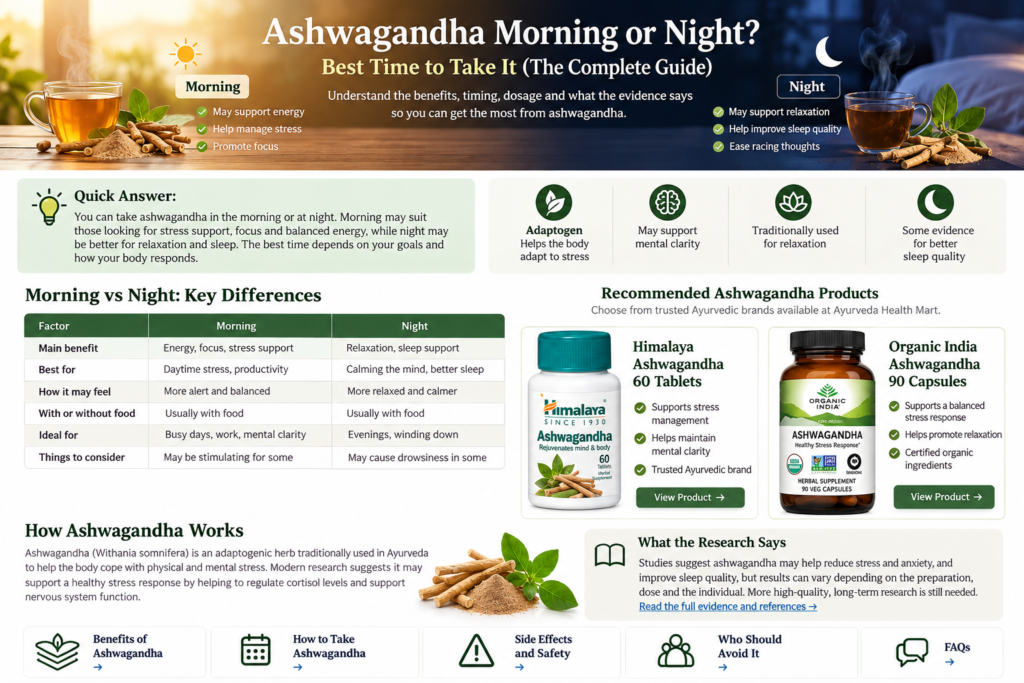
Quick answer: There is no clinically established “best” clock time for everyone to take ashwagandha. Morning can fit a daytime routine; evening can be convenient when sleep is the main wellness goal. Your product’s formulation, label directions, tolerance and consistency matter more than simply choosing AM or PM.
Ashwagandha Morning or Night: Which Is Better?
Ashwagandha (Withania somnifera) has a long history in Ayurveda and is commonly described as a rasayana herb. Today, people often search for the “best time to take ashwagandha” because supplements are used in routines centered around stress, sleep and general wellness.
The important point is that research has generally studied specific ashwagandha preparations taken regularly over a period of time—not a simple morning-versus-night contest. NCCIH notes that some preparations may be useful for stress and insomnia, while studies vary in formulation and are often relatively small. A systematic review of sleep trials also found a modest improvement in overall sleep, but the evidence should not be generalized to every supplement or every person.
Morning vs Night: At-a-Glance
| Consideration | Morning | Evening |
|---|---|---|
| Routine | Easy to pair with breakfast | Easy to add to a bedtime routine |
| Sleep-focused use | Not necessarily inferior | Often more convenient |
| Drowsiness | May be inconvenient if it makes you sleepy | May fit better if drowsiness occurs |
| With food | Can pair with breakfast if label permits | Can pair with dinner if label permits |
When Taking Ashwagandha in the Morning May Suit You
Morning use is practical when you already take supplements with breakfast or want an easy-to-remember routine. If ashwagandha does not make you drowsy, there is no general rule saying it must be reserved for bedtime.
Some people experience stomach upset, diarrhea or vomiting with ashwagandha. If your product instructions allow it, taking it with food may be easier to tolerate than taking it on an empty stomach.
When Taking Ashwagandha at Night May Suit You
Evening use is commonly chosen when sleep is the main reason someone is exploring ashwagandha. A 2021 systematic review and meta-analysis included five randomized trials and reported a small but statistically significant improvement in overall sleep. The authors also emphasized limitations and the need for more safety information for longer-term use.
This does not mean that taking any ashwagandha capsule immediately before bed will work as a sleeping pill. Extract type, dose, study duration and participant characteristics differed across research.
Featured Ashwagandha Options
If you are comparing formulations, Ayurveda Health Mart currently offers two different formats. Always follow the label supplied with the specific product rather than transferring dosing instructions from one brand to another.
Himalaya Ashwagandha – 60 Tablets
A tablet-format option from Himalaya Wellness. The product page includes ingredient details, directions, traditional-use context and safety information.
View Himalaya Ashwagandha 60 Tablets →
Organic India Ashwagandha – 90 Vegetarian Capsules
A vegetarian-capsule option from Organic India for people who prefer a capsule format. Review the product-specific directions before deciding when to take it.
Does Ashwagandha Make You Sleepy?
It can for some people. NCCIH lists drowsiness among possible side effects. If you are trying a product for the first time, pay attention to how you respond before driving or performing tasks that require alertness. Sedating medicines and supplements can also create interaction concerns.
Should You Take Ashwagandha With Food?
There is no single food rule that overrides the manufacturer’s directions. If your label allows either approach and you experience digestive discomfort, taking the supplement with a meal may be easier on your stomach. What matters most is following the directions for the exact formulation you purchased.
How Long Does Ashwagandha Take to Work?
Ashwagandha should not be thought of as an instant-effect supplement. Research trials usually assess outcomes after repeated use over weeks. The 2021 sleep review found stronger effects in some subgroups using treatment for eight weeks or longer, but this is a research observation—not a promise that an individual will notice a result at eight weeks.
Do not increase the dose simply because you do not notice an immediate effect.
Can You Split Ashwagandha Between Morning and Evening?
Only when the specific product label supports divided dosing or a qualified healthcare professional recommends it. Different products may use different plant parts, extracts and concentrations, so a schedule used for one supplement should not automatically be copied to another.
Who Should Be Especially Careful?
NCCIH advises against ashwagandha during pregnancy and breastfeeding and notes concerns for people with thyroid or autoimmune disorders or those approaching surgery. Potential interactions include medicines used for diabetes, high blood pressure, immune suppression, seizures, sedation and thyroid hormone treatment. Rare cases of liver injury have also been associated with ashwagandha supplements.
If you take prescription medicines or have a chronic medical condition, discuss the supplement with a qualified healthcare professional before adding it to your routine.
Related Ashwagandha Guides
For a broader overview covering traditional context, uses and dosing considerations, read our Ashwagandha Benefits: Uses, Dosage & Best Time to Take It.
If stress and sleep are your main interests, continue with Ashwagandha for Stress and Sleep: What Does the Evidence Say?.
Frequently Asked Questions
Is it better to take ashwagandha in the morning or at night?
Neither time has been established as universally superior. Choose a time that fits your product directions, purpose and tolerance, and prioritize consistency.
What is the best time to take ashwagandha for sleep?
Evening may be a convenient choice for a sleep-focused routine, but research does not establish one precise bedtime interval that applies to all products.
Can I take ashwagandha every day?
Follow your specific label and professional guidance. NCCIH notes that short-term use may be safe for some people, while there is insufficient information to draw conclusions about long-term safety.
Can I take ashwagandha on an empty stomach?
Check the product label. If it causes digestive discomfort and the directions permit use with food, taking it with a meal may be preferable.
Can I take ashwagandha with sleeping medicine?
Do not assume the combination is safe. Because ashwagandha can cause drowsiness and may interact with sedatives, discuss the combination with a healthcare professional.
Evidence & References
- National Center for Complementary and Integrative Health (NCCIH): Ashwagandha — usefulness and safety
- Cheah KL et al. Effect of Ashwagandha extract on sleep: systematic review and meta-analysis
- 2024 systematic review and meta-analysis of Withania somnifera for anxiety and insomnia
Medical disclaimer: This article is for general educational purposes and is not intended to diagnose, treat, cure or prevent disease. Supplement choice and dosing should be individualized with an appropriate healthcare professional when medical conditions or medicines are involved.